
Sauna
Heat as medicine.
Science as practice.
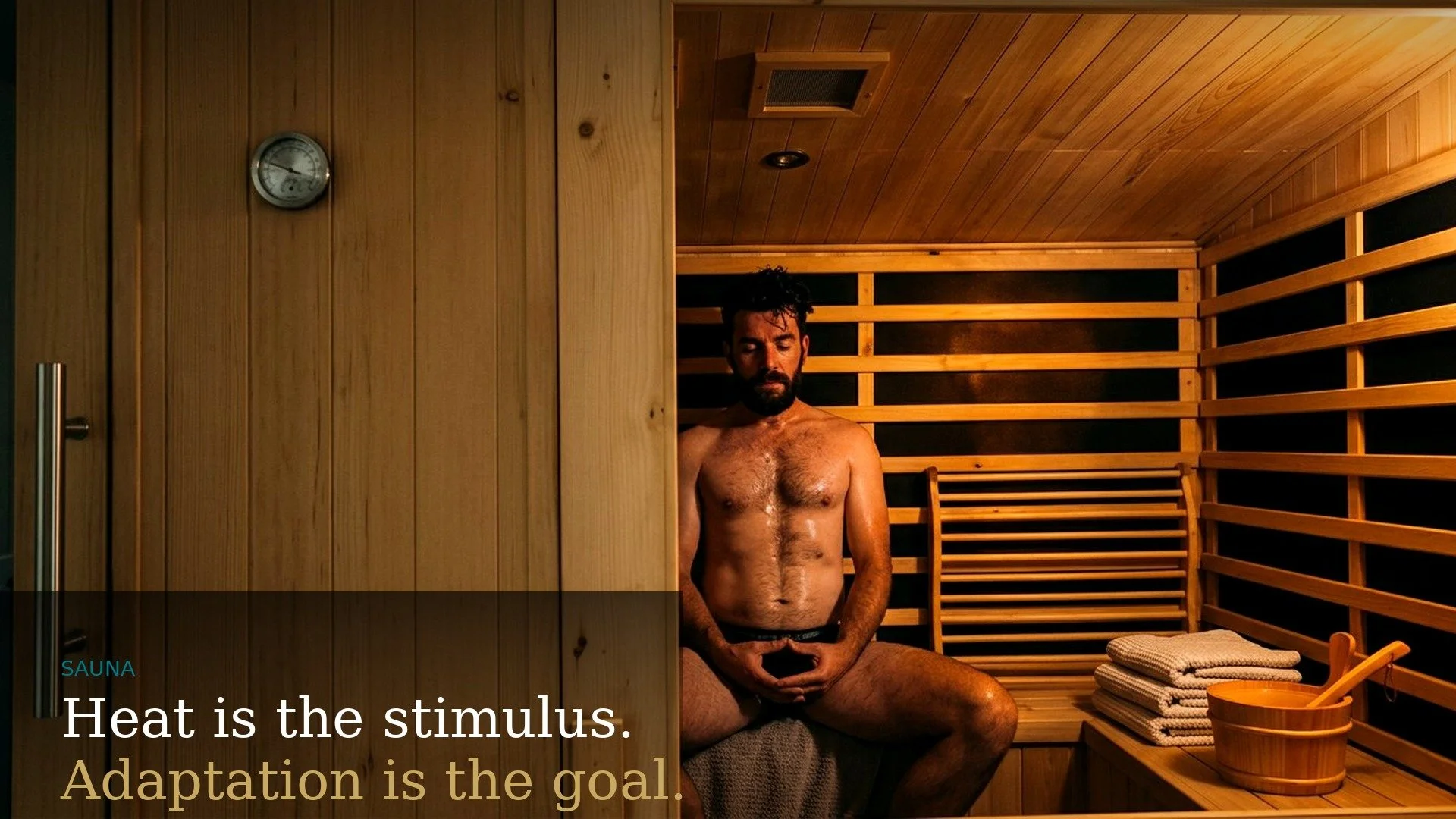
Sauna has been part of human health practice for thousands of years. The Finns knew something the rest of the world is only now quantifying. Deliberate heat exposure drives cardiovascular adaptation, clears the lymphatic system, supports deep tissue recovery and shifts the nervous system in ways that few interventions can match.
Our private sauna room offers both infrared and traditional steam. You choose the experience. Infrared penetrates deeper into tissue at lower ambient temperatures. Steam at 80 to 95 degrees delivers the full traditional sauna experience with the added respiratory and skin benefits of humid heat. Both are deeply effective. Both are yours for 30 minutes, privately, at your own pace.
Fits 6, comfortable for 4
Duration
30 minutes
Type
Infrared or steam
your choice
Infrared Temp
Up to 60°C
Steam Temp
80–95°C
Capacity
Up to 6 people
4 comfortably
Monitoring
Vitals before and after
+ optional HRV analysis
Privacy
Private room
with ensuite shower
Choose your heat
Infrared or steam
Infrared
Up to 60°C · dry heat
Infrared wavelengths penetrate 4 to 5 centimetres into tissue, heating the body from the inside rather than just warming the surrounding air. At lower ambient temperatures, infrared produces a deeper sweat response and more direct muscular and connective tissue effects. It is the preferred choice for clients focused on muscle recovery, chronic pain, inflammation reduction and deep tissue work. The lower ambient temperature also makes it more accessible for those newer to sauna.
Steam
80–95°C · humid heat
Traditional Finnish-style steam sauna with water poured over heated rocks, reaching ambient temperatures of 80 to 95 degrees. The humid heat opens airways, deeply cleanses the skin through profuse sweating, and produces the full cardiovascular response associated with sauna research. Steam is the preferred choice for respiratory benefits, skin health, cardiovascular conditioning and the authentic sauna experience. Sauna hats are available to protect the head and extend session comfort.
Your session
What to expect
Arrival and vitals
Blood pressure, temperature and oxygen saturation are recorded before your session for safety and to give you a baseline to compare against afterwards. Optional HRV analysis is available, measuring RMSSD, DFA alpha 1, heart rate and HF/LF ratio, providing a precise picture of your autonomic nervous system state before the heat stimulus.
Your private room
The sauna room is entirely private. A sauna towel is provided for inside the cabin and a fresh fluffy towel waits for you afterwards. Body wash and your own ensuite shower are available. Sauna hats are provided if you want them. The room is yours for the full 30 minutes at your own pace.
30 minutes of heat
Self-guided at your own pace. Choose infrared up to 60 degrees or steam between 80 and 95 degrees. Hydrate well before you arrive. The session is about letting the heat do its work: the cardiovascular response, the sweat response, the tissue heating. Most clients find a rhythm of sitting, resting and adjusting position through the session.
Post-session shower and vitals
A full shower with body wash and towels provided. Vitals are checked again post-session. Blood pressure typically drops meaningfully after sauna. The shift in your readings is a direct marker of the cardiovascular and nervous system response the heat has produced. If you opted for HRV analysis, your pre and post readings show the autonomic shift in detail.
What it does
Key outcomes
Cardiovascular conditioning
Deep muscle recovery and tension release
Skin cleansing and renewal
Respiratory health support
Inflammation reduction
Deep relaxation and stress relief
Research-backed
The science
During a sauna session, core temperature rises and the cardiovascular system responds as it would to moderate to vigorous aerobic exercise. Heart rate rises, cardiac output increases and blood vessels dilate throughout the body. A 2025 review in Frontiers in Cardiovascular Medicine confirmed that the physiological responses to sauna bathing closely resemble those of moderate to vigorous aerobic exercise, activating heat shock proteins, endothelial nitric oxide synthase and vasodilation mechanisms (Sastriques-Dunlop et al., 2025). This cardiovascular conditioning without the mechanical load of exercise is one of the most significant findings in sauna research, particularly for populations who cannot train intensively. At the cellular level, heat triggers the production of heat shock proteins, molecular chaperones that repair damaged proteins, protect cells from subsequent stress and play a direct role in cellular resilience and longevity.
Infrared and steam sauna produce overlapping but distinct physiological effects. A 2025 study in the American Journal of Physiology compared the two directly and found that traditional steam sauna produces a stronger cardiovascular and thermoregulatory response, including greater core temperature rise and cardiac output increase (Akerman et al., 2025). Infrared operates at lower ambient temperatures but penetrates approximately 3 to 4 centimetres into fat tissue and the neuromuscular system, producing a deeper tissue heating effect at more tolerable temperatures, peer-reviewed evidence confirms this penetration depth specifically (Mero et al., 2015). This makes infrared particularly effective for muscle recovery, chronic pain and musculoskeletal conditions where tissue penetration matters. The long-term mortality and cardiovascular health data from Finnish cohort studies is based on traditional steam sauna. For recovery and deep tissue work, infrared has the edge. For cardiovascular conditioning and the full sauna experience, steam produces a stronger response.
Sweat contains water, electrolytes, urea, ammonia and trace amounts of various metabolic compounds. Sauna-induced sweating produces a significant increase in sweat volume and rate. The heat also opens pores, supporting skin surface clearance and renewal. Regular sauna use has been associated with improved skin hydration, reduced acne and improved skin texture through the combined effects of heat exposure and profuse sweating. It is worth being clear that the kidneys and liver remain the primary detoxification organs. Sauna supports rather than replaces these systems, and claims about heavy metal clearance through sweat are not as strongly supported by evidence as the skin health and sweat-volume benefits.
Heat stress triggers a significant release of growth hormone, with peer-reviewed studies confirming meaningful increases following sauna sessions. The magnitude varies depending on protocol, temperature and frequency. Growth hormone drives muscle repair, fat metabolism and cellular regeneration. Research on far-infrared sauna specifically confirmed significant growth hormone increases in both strength and endurance recovery contexts, alongside the deep tissue penetration effect of infrared wavelengths at 3 to 4 centimetres (Mero et al., 2015). For athletes and physically active clients, the growth hormone response from regular sauna use supports recovery between training sessions alongside the direct effects of heat on muscular tension release and connective tissue flexibility.
The humid heat of steam sauna opens airways and supports mucociliary clearance, the process by which the respiratory tract clears mucus and pathogens. Regular sauna use has been associated with reduced frequency of respiratory infections and improved respiratory function in people with conditions including asthma and chronic bronchitis. The anti-inflammatory effects of heat exposure, mediated through heat shock proteins and suppression of pro-inflammatory cytokines, also reduce systemic inflammation over repeated sessions, supporting autoimmune and chronic inflammatory conditions alongside the direct respiratory benefit.
Full research references on the Sauna science page →
Sequence it
Best combined with
Sauna works powerfully as a standalone session. It works even better when followed by cold, or when used as part of a full recovery sequence.
Contrast Therapy
The most complete thermal protocol we offer. Sauna primes the vascular system and initiates heat adaptation. Cold plunge drives the contrast response. Two cycles deepens everything. This is contrast therapy as a formal double cycle session.
View Contrast Therapy →Ice Plunge
Sauna followed by a cold plunge as a single informal contrast cycle. A powerful combination for recovery and nervous system training without the full double cycle protocol.
View Ice Plunge →Float REST
Sauna relaxes the musculature and opens the vascular system. Float REST after sauna takes the nervous system into a depth of recovery it cannot reach from rest alone.
View Float REST →